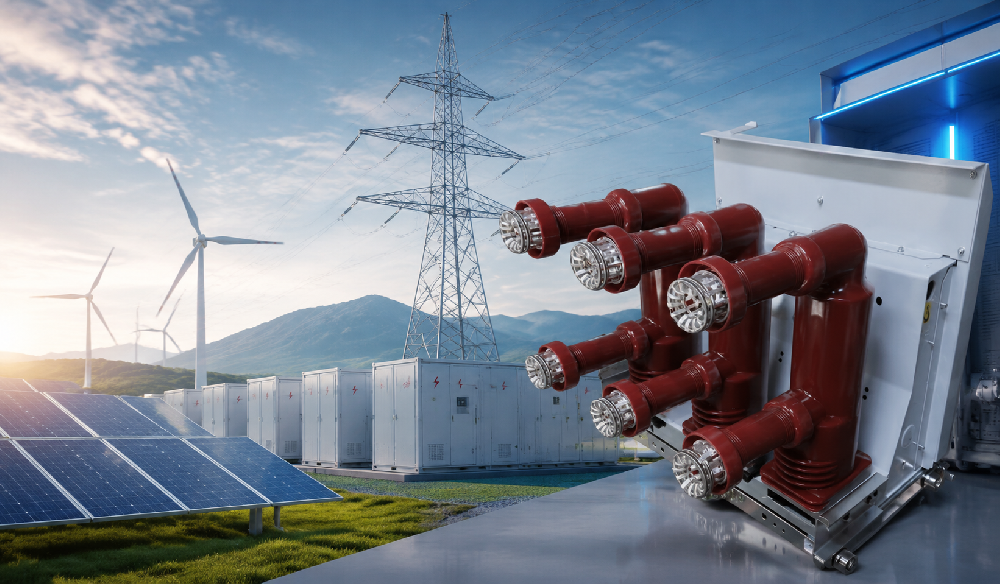
How Renewable Energy Integration Is Reshaping Demand for MV Switchgear
Why Vacuum Circuit Breakers Are Central to This Shift
Introduction
If your company has been supplying medium voltage (MV) switchgear to solar, wind, or energy storage projects over the past couple of years, you've likely noticed a shift: customers no longer just ask whether a breaker is durable — they ask whether it can handle frequent switching, be monitored remotely, and cope with bidirectional power flow. This isn't a one-off project requirement. It reflects a structural change in MV switchgear demand driven by the scale-up of renewable grid integration. For panel integrators and RMU manufacturers, understanding this shift matters more than chasing any single order — it determines which core components to stock and which suppliers to build long-term relationships with over the next two to three years.
Renewable Integration Is Rewriting How the Grid Operates
In a conventional distribution network, power flows in one direction — from substation to end user — and switching devices sit mostly static, operating infrequently. Large-scale integration of solar PV plants, wind farms, and battery energy storage systems (BESS) introduces bidirectional and even multi-directional power flow: solar exports power back to the grid during the day, storage discharges to cover evening peaks, and wind output fluctuates with weather, requiring frequent reconnection. Switching devices are no longer occasional protection elements — they must withstand far more frequent open/close operations than traditional applications demand.
At the same time, renewable sites typically use a centralized collector configuration with multiple parallel feeders — a mid-sized solar collector substation may include dozens of switching units, where any single unit's reliability issue can affect the whole plant's generation efficiency and O&M cost. This is why several international market research firms have consistently listed grid modernization and renewable integration as primary growth drivers for the MV circuit breaker market — the demand structure has shifted from pure capacity expansion toward higher expectations for switching device lifespan, response speed, and remote controllability.
Why Vacuum Circuit Breakers Are the Preferred Choice
In applications demanding frequent operation and stringent reliability, vacuum circuit breakers (VCBs) offer clear advantages over conventional SF6 or oil breakers. The vacuum interrupting medium doesn't depend on gas pressure or ambient temperature, so VCBs perform reliably in outdoor wind farms and solar sites with high altitude or wide temperature swings. Mechanical life typically exceeds 10,000 operations — far above what renewable sites need for routine dispatch switching. And since no SF6 gas is involved, VCBs avoid the increasingly strict greenhouse-gas emission regulations now shaping equipment selection — a criterion that has already become an explicit technical threshold in some European and Middle Eastern tenders.
Liqiang's indoor vacuum circuit breaker series, VS1/ZN63-12, is engineered around exactly these requirements. Key technical parameters are summarized below for integrators evaluating selection options:
Parameter | VS1/ZN63-12 Value | Relevance to Renewable Applications |
Rated Voltage | 12 kV | Matches mainstream PV/wind collector-line voltage class |
Rated Current | 630 – 3150 A (selectable) | Fits collector stations of varying capacity |
Rated Short-circuit Breaking Current | 20 / 25 / 31.5 kA | Meets fault-level requirements at the point of interconnection |
Rated Short-time Withstand Current (4s) | 20 / 25 / 31.5 kA | Protects equipment during fault conditions |
Mechanical Life | ≥10,000 operations | Handles frequent dispatch switching typical of renewable sites |
Operating Mechanism | Spring-operated, manual/motorized | Supports SCADA remote control |
Applicable Standard | IEC 62271-100 / GB1984 | Meets international tender qualification requirements |
Worth noting: the VS1/ZN63-12 series uses a spring-operated mechanism with optional motorized operation and remote-control interfaces, allowing seamless integration with a site's SCADA system for unmanned remote switching and condition monitoring — a capability renewable sites increasingly require to reduce on-site staffing.
Four Typical Application Scenarios
Based on Liqiang's recent project experience, VCB applications in renewable-related settings concentrate in four areas: solar PV collector stations, which need to withstand frequent dispatch switching and long maintenance-free intervals; wind farm feeder switchgear, typically installed outdoors and requiring stronger resistance to impact and pollution; BESS and microgrid installations, where frequent charge/discharge cycling places higher demands on electrical life; and data center power rooms — not strictly a renewable application, but one with reliability and maintenance-interval requirements closely resembling renewable sites, and a fast-growing segment for the VCB product line.
Conclusion
Renewable grid integration is bringing more than incremental market volume — it's re-screening which MV switchgear technology path wins. Suppliers who can demonstrate solid product data on frequent switching endurance, remote monitoring, and environmental compliance are best positioned to capture long-term orders in this demand-structure shift. Liqiang completes full type testing in strict accordance with IEC 62271-100, holds supplier qualifications with State Grid and China Southern Power Grid, and offers customized MV vacuum circuit breakers and complete switchgear solutions for solar, wind, and storage projects.
If you're selecting switchgear for a renewable energy project or looking for a stable long-term VCB supplier, feel free to reach out for technical discussion and a quotation.

 English
 China
China Русский