Global Market Access Standards Guidefor High-Voltage Switchgear
A Quick Reference to Certification Standards by Country
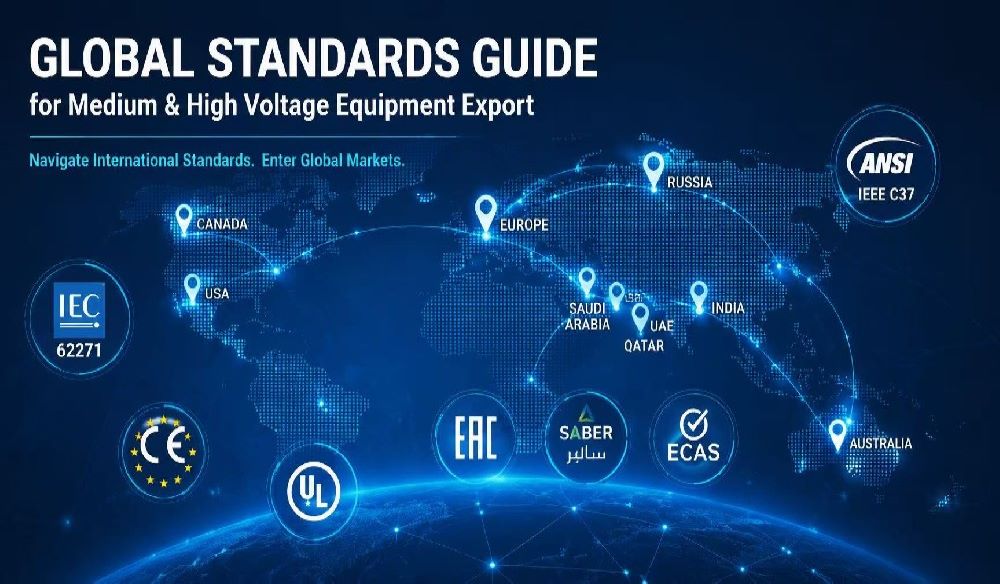
For manufacturers and exporters of medium- and high-voltage switchgear, understanding the certification standard landscape in each target market is the essential first step to entering international markets. This guide outlines the key standards and market access requirements across major global markets, giving your team a clear, actionable foundation.
Two Global Standard Systems
The global high-voltage switchgear standards landscape is not unified. The mainstream market is divided into two major camps:
● IEC 62271 series — the international framework adopted by over 170 countries across Europe, Asia, the Middle East, Africa, and Latin America;
● ANSI/IEEE C37 series — the North American framework, primarily applicable to the United States and Canada, with limited influence in select other regions.
Beyond technical standards, many countries layer on mandatory certification schemes, local additional requirements, and environmental regulations. This guide covers the current standards landscape and market entry thresholds across major target markets, helping your team stay informed at every stage — from quoting and design to certification and market expansion.
Key Technical Differences: IEC vs. ANSI/IEEE
Parameter | IEC 62271 System | ANSI/IEEE C37 System |
Transient Recovery Voltage (TRV) | Based on RRRV (rate of rise of recovery voltage), using standardized current classes | Uses both RRRV and TRV peak value, with K-factor (current correction factor) |
Short-circuit current rating | Symmetrical RMS value (Isc, AC component) | Symmetrical RMS value with K-factor, allowing higher breaking capacity within rated voltage range |
Rated voltage expression | Um (maximum system voltage) | Umax (maximum equipment voltage) |
Typical voltage levels | 12 kV, 24 kV, 40.5 kV, 72.5 kV... | 15 kV, 25 kV, 38 kV, 72.5 kV (some differ from IEC) |
Type test methodology | Primarily direct testing (IEC 62271-100) | Per IEEE C37.09; differs from IEC methods |
Certification bodies | Typically KEMA, CESI, and equivalents | UL listing, or IEEE member laboratories |
Key Markets at a Glance
China
Uses GB/T standards (largely equivalent to IEC 62271 series): vacuum circuit breakers → GB/T 1984; load break switches → GB/T 3804; disconnectors → GB/T 11022. No mandatory CCC certification applies to high-voltage switchgear, but entering the State Grid or Southern Power Grid supply chain requires passing a grid connectivity review and compliance with the Q/GDW enterprise standard series (e.g., the Five-Prevention interlock requirements).
EU / UK
Uses EN IEC 62271 series; technically identical to IEC. High-voltage switchgear falls outside the Low Voltage Directive (LVD) mandatory CE marking scope. The most consequential regulation is EU F-gas Regulation 2024/573: SF6 gas will be prohibited in new equipment rated 24 kV and below from 2026 onwards, with the ban progressively extending to higher voltage levels through 2032.
★ Vacuum products contain no SF6 — inherently compliant with EU F-gas regulations, and exceptionally well-positioned to benefit from a major and sustained policy tailwind in the European market.
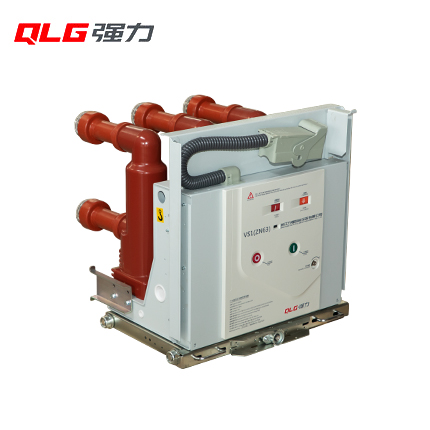
Leading Vacuum Circuit Breaker Manufacturer
Zhejiang Liqiang provides high-performance, reliable VCB solutions for global smart grids. Contact our technical experts for customized quotes and bulk pricing.
Get a Quote →
USA / Canada
Must comply with the ANSI/IEEE C37 series, including IEEE C37.04 (ratings), C37.06 (preferred ratings), and C37.09 (type test procedures). Products entering the North American market require separate type testing under ANSI/IEEE. We recommend evaluating the balance between certification costs and target market scale before committing.
India
IS/IEC 62271 series is now adopted. Market entry is primarily governed by tender technical specifications from major utilities (NTPC, PowerGrid, etc.). Type test reports must be no more than 5 years old.
Middle East (Saudi Arabia / UAE / Qatar, etc.)
IEC serves as the technical basis, but mandatory certifications apply: Saudi Arabia requires a Certificate of Conformity via the SABER platform; the UAE requires ECAS certification. Extreme climate conditions (ambient temperatures of 55°C and above, severe sand and dust) impose additional requirements on IP protection ratings and insulating materials.
Russia / Eurasian Economic Union (EAEU)
Mandatory EAC certification and EAC labelling is required, covering Russia, Kazakhstan, Belarus, and two other member states. Certification is typically valid for 3 to 5 years. The current geopolitical environment should be factored into the choice of certification body.
Australia / Southeast Asia / Other IEC Markets
All follow IEC 62271 series. Market entry relies primarily on type test reports combined with local grid operator technical specifications. In Australia, AS 2067 (the substation and high-voltage installations standard) should also be noted.
Key Recommendations
Regardless of the target market, the following three type test reports form the foundation of export compliance:
● IEC 62271-100 Type test report for AC circuit breakers (vacuum circuit breakers)
● IEC 62271-102 Type test report for disconnectors and earthing switches
● IEC 62271-200 Type test report for metal-enclosed switchgear (including load break switch assemblies)
For markets with mandatory certification requirements (EAC for the EAEU, SABER for Saudi Arabia, ECAS for the UAE), we recommend initiating the certification application 6 to 12 months in advance, working with a third-party body recognized in the target country (e.g., TUV, Bureau Veritas, SGS).
★ As the EU SF6 ban continues to advance, vacuum technology products will gain an ever-growing competitive advantage across mainstream IEC markets worldwide.
This document is compiled from publicly available standards literature. For specific compliance decisions, always refer to the latest official guidelines from the relevant certification authority in your target country.
 English
 China
China Русский