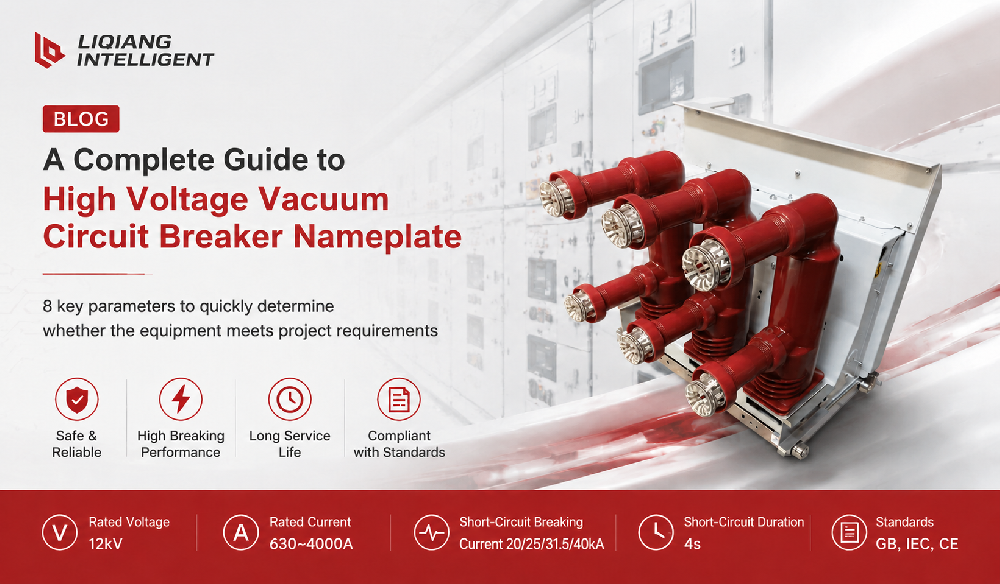
Understanding a High Voltage Vacuum Circuit Breaker Nameplate
8 Key Parameters to Quickly Check Whether Equipment Meets Your Project Requirements
When purchasing or accepting medium- and high-voltage switchgear, the nameplate is the piece of information most often overlooked — yet it best reflects the equipment's true capabilities. Once you understand the core parameters on a nameplate, you can judge within minutes whether a circuit breaker meets your project's technical requirements. The example below uses the nameplate of an indoor high-voltage vacuum circuit breaker to walk through each parameter.
Nameplate Information
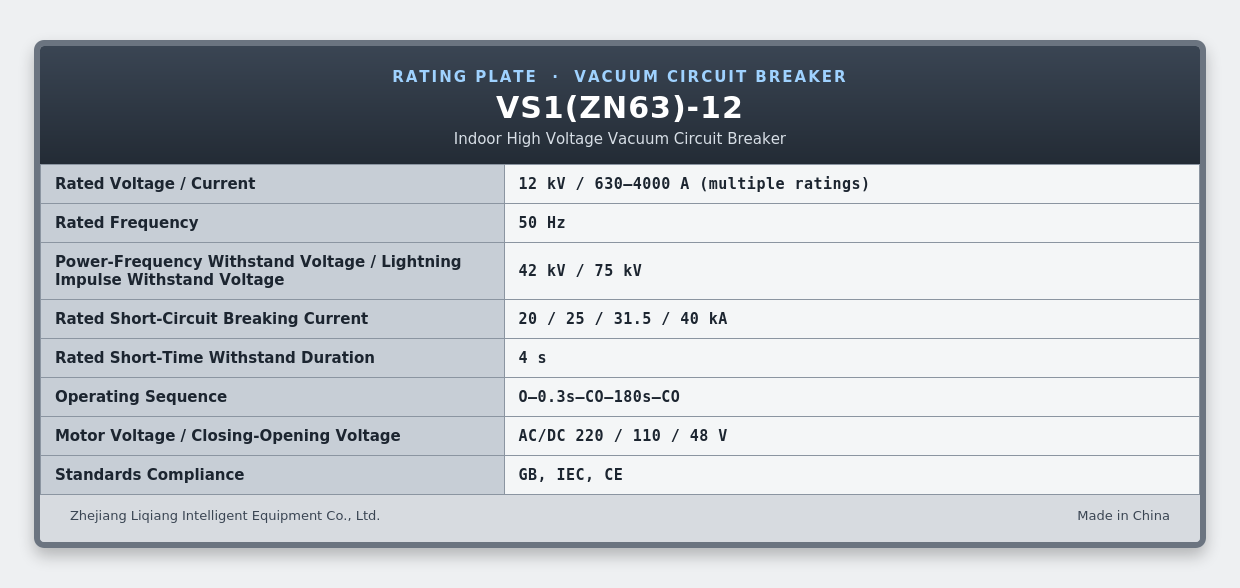
Figure: Nameplate information for a VS1(ZN63)-12 indoor high-voltage vacuum circuit breaker
Parameter Explanations
Parameter | Nameplate Value | Meaning |
Rated Voltage / Current | 12 kV / 630–4000 A (multiple ratings) | Rated voltage corresponds to the system voltage class the equipment belongs to and determines the insulation design margin. Rated current is the maximum continuous load current the breaker can carry long-term without exceeding its temperature rise limit; it is typically offered in several current ratings for incoming, feeder, and other panel types. When selecting a breaker, first determine the voltage class from the substation's system voltage, then choose a current rating no lower than the actual maximum load current — this is the primary basis for breaker selection. |
Rated Frequency | 50 Hz | The breaker must match the system frequency of the grid it is installed on. China and most markets in Asia, Africa, and Latin America use 50 Hz, while North America and parts of the Middle East and Central/South America use 60 Hz. Frequency affects contact travel matching and the design of certain auxiliary components. For projects exporting to 60 Hz grids such as North America, always confirm with the manufacturer before ordering that a 60 Hz version is available, to avoid equipment that cannot be commissioned due to a frequency mismatch. |
Power-Frequency Withstand Voltage / Lightning Impulse Withstand Voltage | 42 kV / 75 kV | Together these two values define the equipment's insulation level. The power-frequency withstand voltage is the 1-minute AC withstand test value, simulating relatively slow overvoltages such as switching surges. The lightning impulse withstand voltage uses the standard 1.2/50 µs waveform to simulate the transient high-voltage surge produced by a lightning strike. Both values must meet or exceed the insulation coordination requirements of the installation site — the higher the value, the stronger the equipment's ability to withstand overvoltage flashover. |
Rated Short-Circuit Breaking Current | 20 / 25 / 31.5 / 40 kA | This is the maximum current the breaker can safely interrupt without damage when a short-circuit fault occurs on the system. Several standard ratings are usually offered for grids with different short-circuit capacities, and this value is the core indicator of the vacuum interrupter's arc-quenching capability. When selecting a breaker, choose a rating no lower than the maximum system short-circuit current at the installation point (with margin for future grid expansion), to avoid a breaking failure under the actual fault current. |
Rated Short-Time Withstand Duration | 4 s | This is the maximum time the breaker can carry the rated short-circuit current in the closed position without thermal damage or mechanical deformation. It evaluates thermal and dynamic stability rather than breaking capability. Four seconds typically covers the full fault-clearing time, including protection relay operation and trip output. A larger value indicates a higher safety margin under abnormal conditions such as protection delay or failure to trip. |
Operating Sequence | O–0.3s–CO–180s–CO, etc. | This specifies the standard sequence of consecutive operations the breaker can perform without maintenance. Taking “O–0.3s–CO–180s–CO” as an example: open first (O), then close-open after a 0.3-second interval (CO, simulating auto-reclosing), then close-open again after a 180-second interval. This sequence verifies whether the equipment can meet the timing requirements of line-protection auto-reclosing, and must be checked when selecting breakers for applications such as overhead lines that require reclosing coordination. |
Motor Voltage / Closing-Opening Voltage | AC/DC 220 / 110 / 48 V | This actually covers two independent circuits. The motor voltage drives the internal energy-storage motor that compresses the closing spring. The closing/opening voltage (control voltage) drives the trip and closing coils that release the spring energy to perform the opening and closing actions. Both can be AC or DC, with common ratings of 220 V, 110 V, and 48 V. DC power is usually supplied from the substation's battery system, ensuring reliable tripping even if the station's AC supply fails — a common choice for protecting the trip circuit. AC power costs less and is typically used where reliability requirements are relatively relaxed. Before ordering, always confirm the voltage against the customer's secondary control power supply on site; a mismatch can prevent the energy-storage motor from charging properly, or cause the opening/closing coils to fail to operate or operate incorrectly. |
Standards Compliance | GB, IEC, CE | GB/GB⁄T are Chinese national standards and form the basic basis for tendering and acceptance on domestic grids. IEC (such as the IEC 62271-100 series) is the International Electrotechnical Commission standard, widely adopted across Belt and Road countries, Southeast Asia, the Middle East, Africa, and most other overseas markets, and is typically a mandatory technical requirement in international tenders. CE marking is required for compliance in the EU market — none of these can be omitted. Export projects should verify that all required certifications are complete and that the certificates are the latest valid versions for the target market. |
Four Details Easy to Overlook
① Rated current reflects normal operating capability, while short-circuit breaking current reflects protection capability at the instant of a fault. Both must be checked separately — neither can be skipped.
② For projects in overseas markets that follow the IEC/CE system, the standards-compliance field is a prerequisite for the equipment to pass acceptance review.
③ The manufacture date is not the same as the installation and commissioning date. It is advisable to clearly define in the contract how the warranty period is calculated, to avoid losing warranty time passively due to a long shipping cycle.
④ Rated frequency, motor voltage, and closing/opening voltage may look like minor supporting parameters, but they are easy to overlook: 50 Hz and 60 Hz grids, and different control voltage ratings, cannot be mixed. For export projects, confirm the actual on-site grid frequency and secondary control power standard with the customer before placing an order, to avoid equipment that cannot be commissioned after arrival.
Conclusion
A single nameplate condenses a circuit breaker's electrical performance and safety margins. Learning to read it is a basic skill for equipment selection, acceptance, and after-sales support. Liqiang Intelligent Equipment specializes in the R&D and manufacturing of medium- and high-voltage switchgear, with products covering the 10kV–40.5kV range and certified to IEC, GB/T, and other standards. Contact our technical team for detailed selection materials.
 English
 China
China Русский