Liqiang Technical Insights
50Hz vs 60Hz: The Global Power Frequency Guide Every Switchgear Buyer Should Know
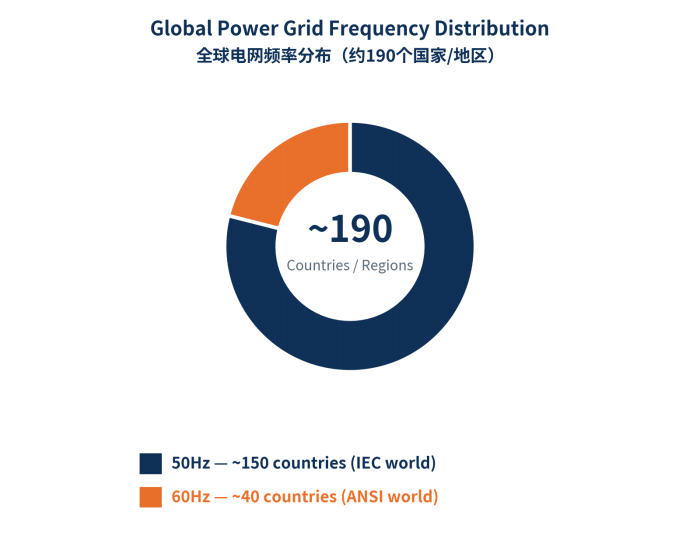
Fig. 1 — Of roughly 190 countries and regions worldwide, about 150 run on 50Hz and about 40 run on 60Hz.
Introduction
When sourcing switchgear, most international buyers open with the same two questions: “What voltage class can you supply?” and “Do you have full type-test reports?” Very few ask a more basic question first: is this equipment designed and tested for a 50Hz grid, or a 60Hz grid? Frequency looks like a small line on a nameplate, but it actually decides which voltage-class series applies, how temperature-rise tests must be run, and whether an existing type-test report is even valid for your market. Of roughly 190 countries and regions worldwide, about 150 run on 50Hz and about 40 run on 60Hz.
1. The Global Power Grid Map: Two Standard Worlds
Global power grids fall into two broad camps. The “50Hz world,” built around IEC standards, covers almost all of Europe; nearly every Middle Eastern country except Saudi Arabia (the UAE, Qatar, Kuwait, Oman, Bahrain, Iran, Iraq, Jordan, Israel, Yemen, and others); most of Asia, including China, India, Indonesia, Vietnam, Thailand, Malaysia, Singapore, Myanmar, Cambodia, Pakistan, Bangladesh, Sri Lanka, the five Central Asian republics, and Mongolia; nearly all of Africa (Egypt, Nigeria, South Africa, Kenya, Morocco, Algeria, and others — Ethiopia is one exception, running 60Hz); Australia and New Zealand; and, in South America, Argentina, Chile, Uruguay, Paraguay, and Bolivia.
The “60Hz world,” built around ANSI standards, is smaller and more concentrated: all of North America (the United States, Canada, Mexico); most of Central America and the Caribbean (Guatemala, Honduras, El Salvador, Nicaragua, Costa Rica, Panama, Cuba, and others); Brazil, Colombia, Venezuela, Ecuador, Peru, Guyana, and Suriname in South America; and, in Asia, Saudi Arabia, South Korea, and the Philippines (Japan is a special case — Tokyo in the east runs 50Hz, while Osaka in the west runs 60Hz). In Africa, Liberia is the only 60Hz country.
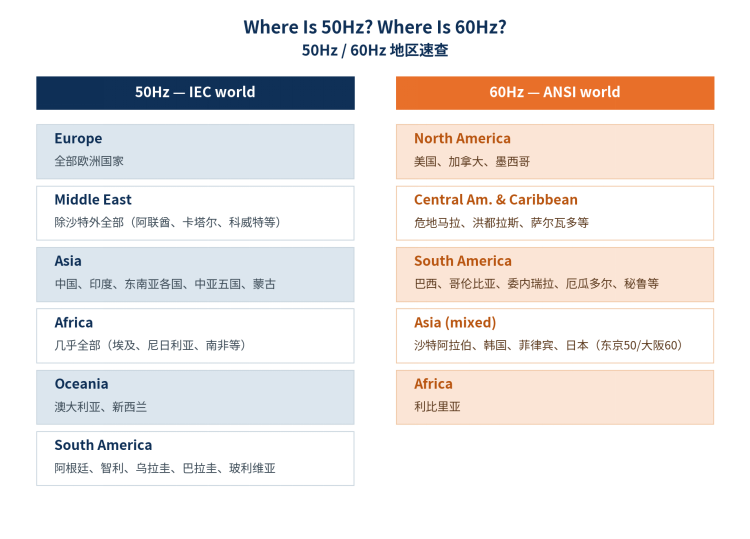
Fig. 2 — Quick reference: which regions run 50Hz, and which run 60Hz.
2. Why Frequency Matters So Much for Switchgear Selection: Three Practical Points
1. The voltage-class series itself is different. 12/24/36kV is the standard IEC voltage series, and it maps naturally onto 50Hz markets — which is exactly why Liqiang's product line lines up directly with major export markets such as Indonesia (20kV systems using 24kV equipment) and Egypt (11/22/33kV systems using 12/22/36kV equipment), with no redesign needed. 60Hz markets generally use a different set of voltage classes altogether: 13.8/25/34.5kV in the United States, 22.9kV in South Korea, and 13.8kV for Saudi Electricity Company (SEC) distribution. So entering a 60Hz market is not really about “changing the frequency” — the real question is whether a derivative model needs to be developed for that market's specific voltage class.
2. Higher frequency means higher eddy-current losses. At 60Hz, the eddy-current and hysteresis losses in a switchgear's conductive parts and ferromagnetic materials run higher than at 50Hz, which shows up directly as higher temperature rise. That means a 60Hz model cannot simply reuse 50Hz temperature-rise test data — it needs its own temperature-rise testing at 60Hz, to confirm that current-carrying parts still stay within the required limits under the new frequency.
3. Saudi Arabia is a hybrid market worth watching closely. It is the only 60Hz country in the Middle East, yet its distribution system (400V/60Hz) follows the IEC standard framework — an “IEC standard + 60Hz” combination. Markets like this set the highest bar for suppliers: equipment must meet IEC design and certification logic and also pass separate 60Hz type tests. This is a detail many Chinese manufacturers targeting Saudi Arabia tend to overlook.
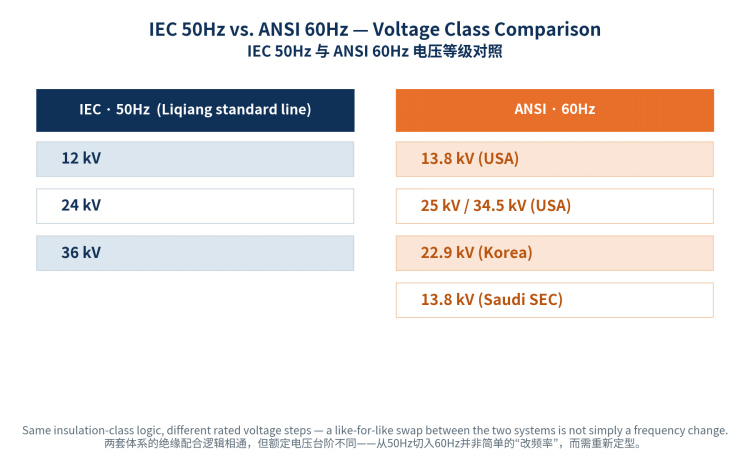
Fig. 3 — Typical IEC 50Hz vs. ANSI 60Hz voltage classes, side by side.
3. Where Liqiang's 12/24/36kV Line Fits
For Liqiang, this frequency map is actually good news. Our full 12/24/36kV product line — vacuum circuit breakers (VCB), load break switches, disconnectors, and earthing switches — is designed from the ground up to IEC 62271 series standards, CE certified and GB/T certified, with State Grid and China Southern Power Grid supplier qualifications. For target markets that run mainly on 50Hz — Southeast Asia, the Middle East (excluding Saudi Arabia), Africa, and Central Asia — our standard product line maps directly onto local voltage classes, with no redesign or re-testing required. That means shorter selection and delivery cycles, and lower integration risk, for buyers.
Tip If you are evaluating opportunities in 60Hz markets or in Saudi Arabia specifically, it helps to confirm your target voltage class early on (13.8kV, 22.9kV, or 34.5kV) and whether a dedicated 60Hz type-test report will be needed. These requirements are best discussed directly with our team, so a frequency mismatch doesn't surface late in the project. |
Conclusion
Frequency might look like a minor line in a grid's parameter sheet, but it's the first real gate that decides whether a switchgear model can be deployed as-is. Before sending out an RFQ, it's worth confirming your market's grid frequency and governing standard first, then matching the right product series to it — that one step will save a lot of back-and-forth later.
Contact Liqiang If you're not sure which category your market falls into, or need a technical check against a specific voltage class, reach out to our team — we can match a standard model to your project location and grid parameters, or assess the feasibility of a custom solution. lq@lqele.com.cn / sales001@lqele.com.cn | +86-188-1507-3988 / +86-131-9537-7506 |
Note: The country frequency classifications in this article are compiled from public sources for early-stage project reference only. Please confirm against the latest technical specifications published by your local grid operator or power authority.

 English
 China
China Русский