What Is STL? A Guide to the World’s Leading Short-Circuit Test Labs — and Is China’s XIHARI an STL Member? Feature · Type Test · IEC 62271 · Updated November 2026 |
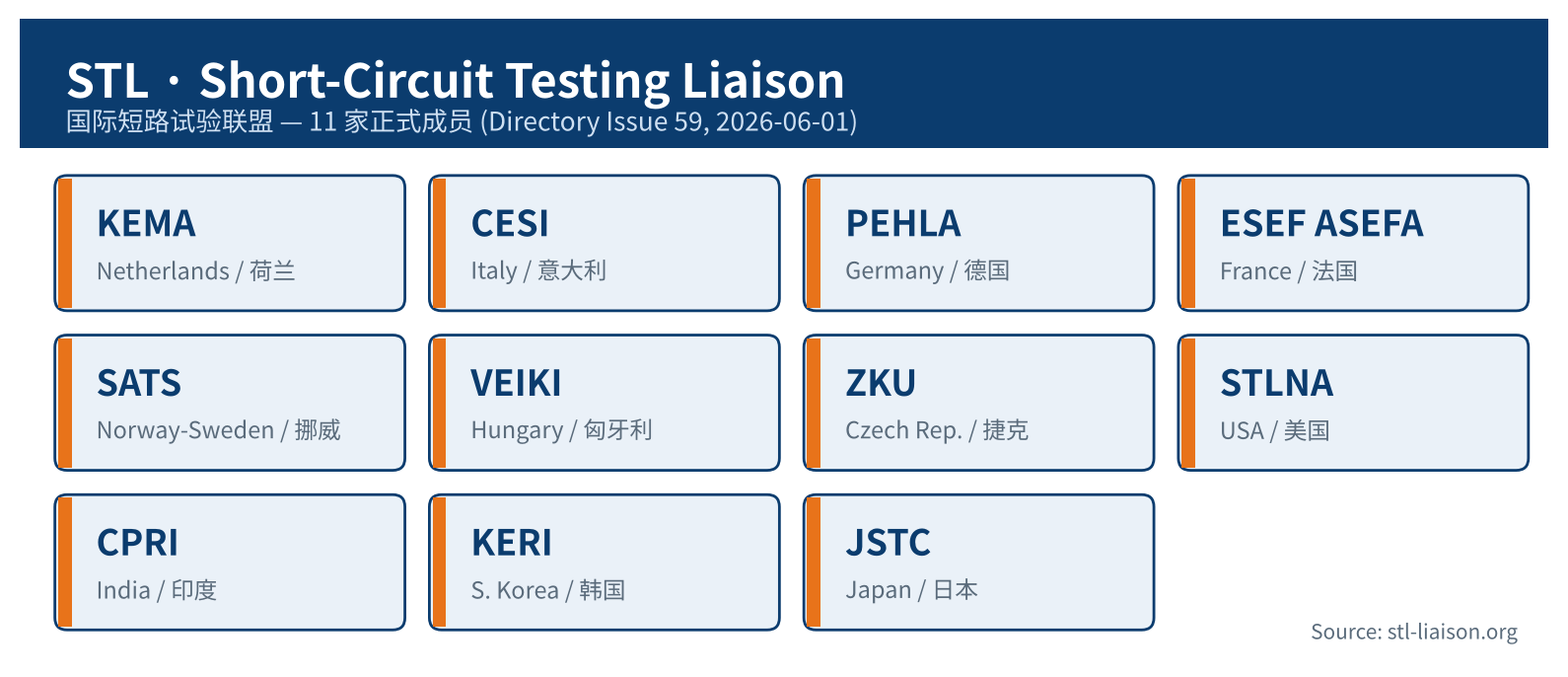
图 1:STL 官网公布的 11 家正式成员
Figure 1: The 11 full members listed on the STL website (Directory Issue 59, 2026-06-01)
Introduction: “Type test reports from STL member labs”
When you buy medium-voltage switchgear, especially vacuum circuit breakers, the technical specification often says one thing: type test reports must come from an STL member laboratory, or from a lab approved by the owner. Behind this line is a real but little-known organisation — STL, the Short-Circuit Testing Liaison.
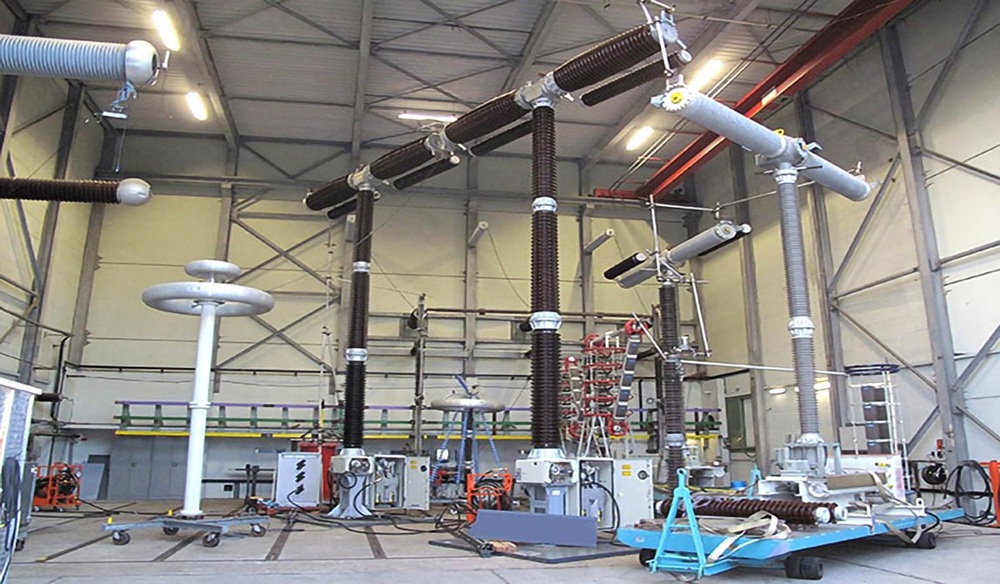
Short-circuit breaking tests need a test source of several thousand MVA. Only a handful of labs in the world can do them, so slots usually must be booked early, and testing and certification are not cheap. This article introduces STL, profiles its leading laboratories, and finally answers a question that is often misreported: is China’s XIHARI (Xi’an High Voltage Apparatus Research Institute) an STL member?
1. What Is STL?
STL was founded in 1969. Its aim is to help laboratories apply IEC standards consistently and present test results in a uniform format. It is not a certification body. It is a cooperation group of independent high-power labs. Membership has clear conditions (from the STL website):
Condition | Details |
Test capability | Tests high-voltage power equipment and has at least one direct short-circuit test facility of 500 MVA or more (three-phase) |
Independence | Widely recognised as competent, and independent of any manufacturer or user interest |
Participation | Able to take an active part in STL’s technical work |
Quota | Only one member or applicant per country or group of countries |
According to the STL directory dated 1 June 2026, there are 11 full members: KEMA, CESI, PEHLA, ESEF ASEFA, SATS, VEIKI, ZKU, STLNA, CPRI, KERI and JSTC. Korean media also notes that full membership is limited to 11 seats with a high entry barrier, and that members’ reports carry strong credibility in the global market.
2. Meet the Leading Laboratories
Europe: the long-established core
KEMA Labs Arnhem (NL) / Prague (CZ) / Chalfont (US) | Founded in Arnhem in 1927 as the Dutch power industry’s test house. On 30 December 2019 the high-voltage testing, inspection and certification business moved from DNV GL to CESI; the deal closed on 2 March 2020 and included the Chalfont lab in the USA. The Arnhem high-power lab is described as the world’s largest, with 10,000 MVA of short-circuit power. The Prague site has two 2,500 MVA generators. |
CESI Milan, Italy | Founded in Milan in 1956 by Ercole Bottani, because major electrical companies needed a “great power laboratory”. ENEL took a majority stake in 1964. Today CESI is the parent of KEMA Labs, with facilities in Arnhem, Prague and Chalfont. |
PEHLA Germany / Switzerland | Short for Prüfung Elektrischer Hoch-Leistungs-Apparate, an association of high-power labs in Germany and Switzerland and a founding member of STL. Its members include the test labs of ABB, Hitachi Energy, GE Grid, Schneider Electric, Siemens Energy and Siemens. |
ASTA / Intertek United Kingdom | According to Intertek, ASTA is a founding member of STL and has served as the STL secretariat since 1969. ASTA is best known for type test certification: for bespoke or short-run products, certificates are issued after sample designs pass tests against national, European or international standards, supported by a network of more than 30 ISO/IEC 17025 accredited labs under the Intertek RTL scheme. |
SATS Norway / Sweden | The Scandinavian Association for Testing of Electric Power Equipment was set up in 1974 by ASEA AB (Sweden) and EFI (Norway). It joined STL as an associate member in 1975 and became a full member in 1984. Its labs include the High Power Laboratory and STRI in Ludvika (Sweden), NEFI/ABB in Skien, Nexans Norway in Halden and SINTEF Energy Research in Trondheim. |
ESEF ASEFA (France), ZKU (Czech Republic) and VEIKI (Hungary) are also on the STL list. Hungary’s VEIKI-VNL appears as DEKRA TIC on the Saudi Electricity Company’s approved list, with short-circuit capability of 380 kV and 200 kA for 1 second.
The Americas and Asia: regional voices
STLNA USA (North America) | STL North America is the regional group. A 2024 liaison report to the IEEE PES Switchgear Committee says it has seven member labs, is now independent of NEMA and incorporated as STLNA, Inc., and takes part in STL work such as the reference shunt project. |
JSTC Japan | The Japan Short Circuit Testing Committee became STL’s first member in Asia in 2001 and leads the Asian and North American part of the STL Shunt Project. In 2003 it started the Asian Meeting of High Power Laboratories (AMHPL), now rotating among China, Japan, India and Korea. |
CPRI India | The Central Power Research Institute. On 19 May 2006, at the 32nd STL Management Committee meeting in Les Renardières, France, its application was approved unanimously and it became a full member. |
KERI South Korea | The Korea Electrotechnology Research Institute has been a full STL member since 2011. In 2026 it hosted the 73rd STL Technical Committee meeting in Gimhae, after hosting an international STL conference in Busan in 2012. |
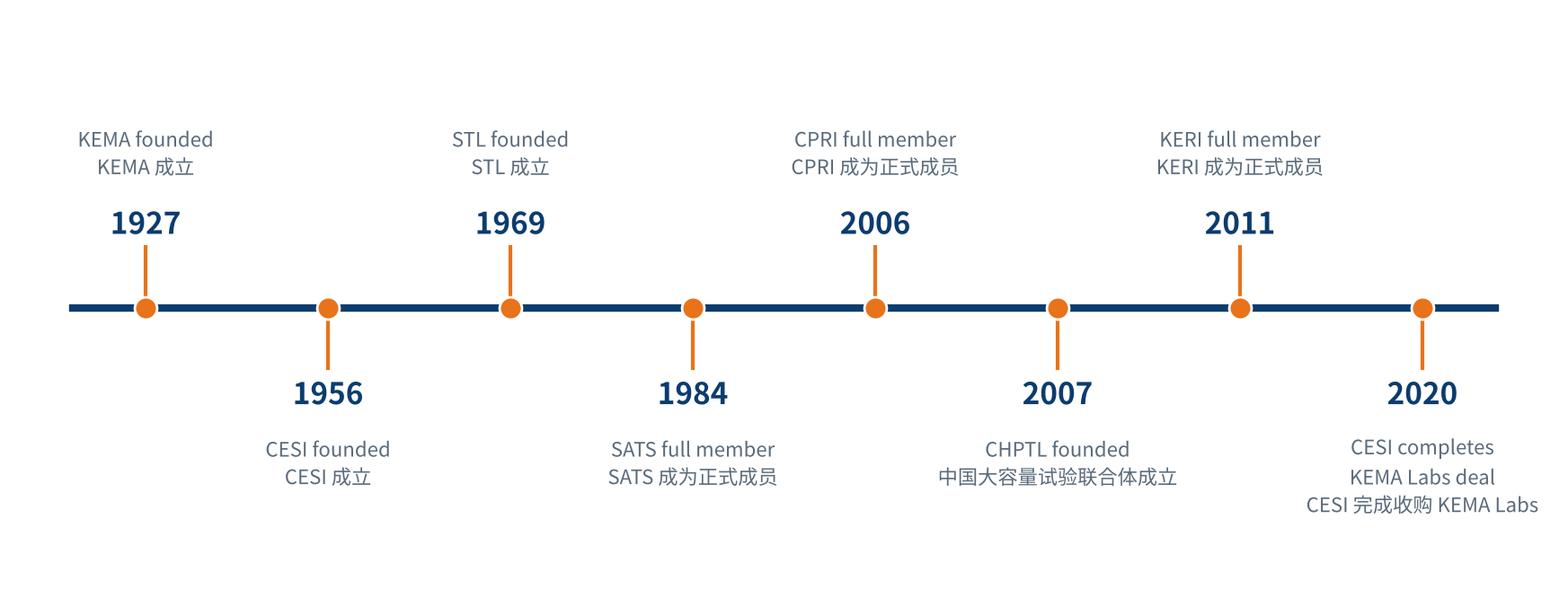
图 2:STL 及部分成员的关键时间点
Figure 2: Key milestones of STL and selected members
3. Why Everyone Wants These Labs
• Scarce facilities: only 11 full members, one per country, and a multi-thousand-MVA test source is a rare asset.
• Widely accepted reports: members follow a common IEC practice, so owners in international tenders accept their reports more easily.
• Scheduling and cost: samples, test plans and slots all need early planning. Booking early and fixing the test scope first saves a lot of trouble.
Three tips for buyers and panel builders 1. Read the type test policy in the tender first. Does it ask for “STL member” labs or “owner-approved” labs? 2. Check the standard edition and sample configuration behind the report (for example IEC 62271-100) against the model you will supply. 3. Check the lab’s ISO/IEC 17025 accreditation scope and confirm the tests are covered. |
4. The Key Question: Is XIHARI an STL Member?
The short answer No. None of the 11 full members on the current STL list is a Chinese organisation. But this does not mean XIHARI was “kicked out”, and it does not mean its reports are “not accepted”. |
Online claims on this topic are confusing because three separate things get mixed together:
1) The list. The STL directory (Issue 59, 2026-06-01) shows 11 members and no Chinese organisation. STL admits only one member or applicant per country or group of countries, and requires test capability and independence.
2) XIHARI’s real role. XIHARI hosts the secretariat of the China High Power Testing Liaison (CHPTL). CHPTL was founded in 2007 and has six formal member units. By its published duties, its management committee coordinates work with STL and follows STL developments, and its technical committee nominates experts to STL technical working groups and reviews proposals sent to the STL technical committee. At the 2017 Asian Meeting of High Power Laboratories (AMHPL) in India, CHPTL attended for China together with CPRI (India), KERI (Korea) and JSTC (Japan). So XIHARI stays in touch with STL and takes part technically through CHPTL, but it is not a full STL member.
3) “Kicked out” has no basis. We found no public record that XIHARI was ever a full STL member, so there was nothing to be kicked out of.
4) Acceptance is decided by the owner. Whether a report is accepted depends on the specific tender. For example, the Saudi Electricity Company’s approved international laboratory list (August 2025) includes XIHARI (Xi’an and Changzhou) alongside VEIKI-VNL (DEKRA TIC), KINECTRICS, FGH/CESI and CEDRA, and the list does not mention STL at all. On the other hand, some owners do require reports from STL member labs. Both practices exist.
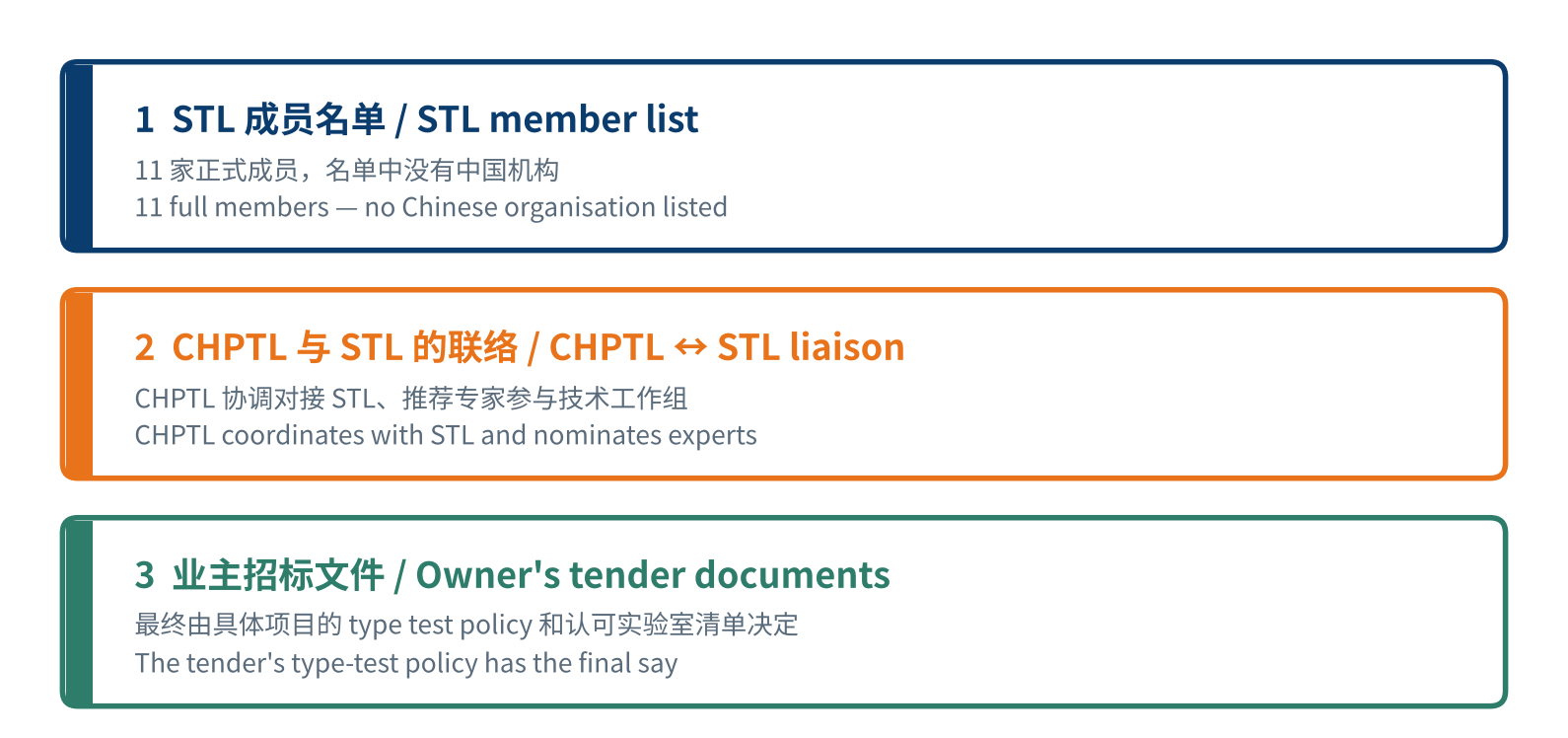
图 3:判断一份试验报告能否被接受,要看三个层面
Figure 3: Three layers that decide whether a test report is accepted
What this means for buyers and suppliers Don’t only ask “is the lab an STL member?” Ask “which labs does my tender accept?” Liqiang can provide type test reports as required by your project and help you check them against the tender’s laboratory requirements. |
Conclusion & Call to Action
STL is a valuable name to know, but it is not the only yardstick. Understanding the member list, each lab’s background and your tender’s requirements will help you avoid costly surprises. If you are preparing specifications for 12kV / 24kV / 40.5kV vacuum circuit breakers, load break switches or switchgear, contact Liqiang and we can review test reports and tender requirements together.
联系方式 / Contact lq@lqele.com.cn | sales001@lqele.com.cn | +86-188-1507-3988 | +86-131-9537-7506 |
Disclaimer: This article is compiled from public information from STL, the laboratories and asset owners, as of November 2026. Member lists and owner requirements may change; please refer to the STL website and your specific tender documents. This is not procurement or legal advice.
参考资料 / Sources
STL 成员名录 / STL Members
ABB:PEHLA 与 STL / PEHLA and STL
CPRI:成为 STL 正式成员 / CPRI becomes full member
JSTC:国际合作 / International Cooperation
AMHPL 2017 India 会议 / AMHPL 2017 meeting
SATS 组织介绍 / SATS organisation (SINTEF)
Intertek ASTA 型式试验认证 / ASTA type test brochure
KEMA(维基百科)/ KEMA (Wikipedia)
CESI(维基百科)/ CESI (Wikipedia)
KEMA Labs 布拉格 / KEMA Labs Prague
KERI 与 STL 技术委员会会议 / KERI hosts STL TC meeting (Herald)
STLNA 联络报告 / STLNA liaison report (IEEE PES)
CHPTL 概况(西高院)/ CHPTL overview (XIHARI)
沙特电力公司认可实验室名单 / Saudi Electricity Co. approved labs (Aug 2025)
 English
 China
 Русский